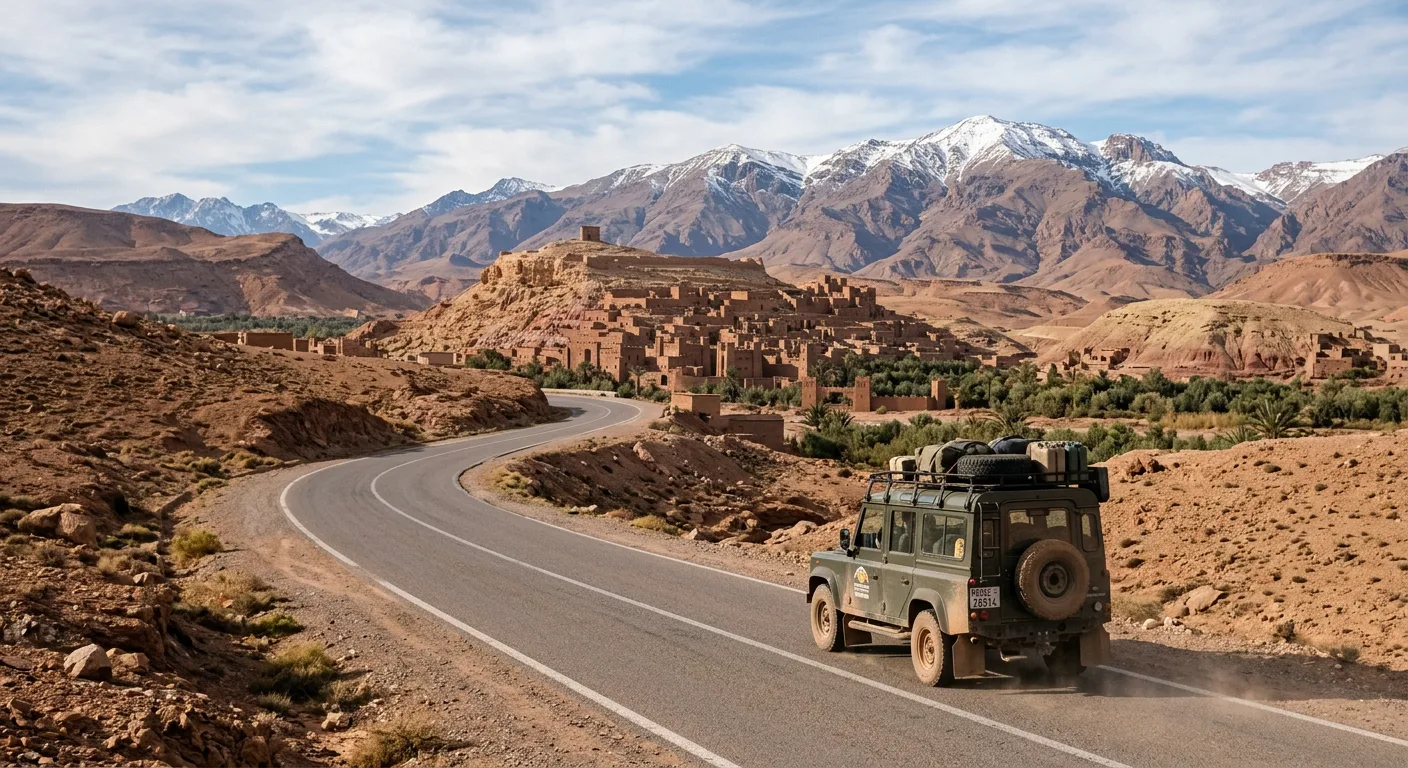
Tangier is the gateway to one of the most rewarding corners of Morocco to explore by road — the Atlantic coast to Asilah, the blue lanes of Chefchaouen in the Rif, the Andalusian medina of Tetouan, all within a couple of hours. It is also a region where driving demands attention. Here is what we tell guests who ask us, honestly, whether they should rent a car.
What are the roads in the north actually like?
The autoroute linking Tangier with Rabat, Casablanca and Fès is excellent: well-surfaced, toll-maintained, clearly signposted. The coast road to Asilah and west to Cap Spartel is good. The picture changes inland: the route into the Rif to Chefchaouen is paved but winding, climbing through tight mountain bends with steep drops and few barriers. Two lorries passing can leave only centimetres. Rural roads can deteriorate after rain. We never recommend a standard rental on a mountain piste.
What about bringing a car on the ferry?
If you drive down through Spain, the Algeciras–Tanger Med ferry takes vehicles. Remember that you land at the large Tanger Med port roughly 40 km east of the city, not in Tangier itself, so factor in the transfer. Carry your registration, insurance green card, passport and rental authorisation (if it's a hire car) for the on-board passport control and the port. Foot passengers from Tarifa land in the city centre and have no car to worry about — often the simpler choice.
How do police checkpoints work?
Checkpoints (barrages) are a normal feature of road travel in the north, especially toward Chefchaouen and Tetouan. An officer steps into the road with a baton; you slow and stop. Have your passport, licence and rental contract ready. Officers check speed — they have radar — and occasionally breathalyse. Morocco has a zero-tolerance drink-driving law: the legal limit is 0.0 g/L. Be courteous and patient. If a fine is issued it is paid in dirhams on the spot; ask for a receipt (un reçu, s'il vous plaît).
Can you park inside the Tangier medina?
The medina and kasbah of Tangier are effectively car-free — the lanes are steep, narrow and stepped. You park in a supervised car park near the edge — gardiens charge 10–20 MAD — and walk up through the gates. The same is true of Chefchaouen's blue medina, Asilah's walled town and Tetouan's old city. Your guesthouse will send someone to meet you at the nearest gate; they routinely manage luggage handoffs at the car park, which matters most if you arrive off the ferry with bags.
What does car hire actually cost?
A small manual (Dacia Sandero category) runs approximately US$25–40 per day from international agencies (Avis, Hertz, Europcar) at Tangier airport. Local agencies advertise lower rates but their insurance and breakdown cover are often inadequate — read the small print. Full collision damage waiver (CDW) and theft protection are worth paying for. Fuel is roughly US$1.20 per litre for petrol; stations are well distributed on the main routes, sparser on the Rif back roads.
Why do most of our guests choose a private driver?
We are not unbiased — we arrange private driver-guides for a living. But the reasons our guests give, after trying to self-drive and then switching, are consistent: the Chefchaouen mountain road was more nerve-wracking than expected, parking at every stop added hours of stress, the checkpoint language was uncomfortable, and they spent the trip watching the road rather than the scenery. A private driver removes all of that. Over a few days of day trips a driver-guide costs roughly US$90–160 per day all-in, which across a group of four is modest per person. You gain a local expert, a fixer, a translator and someone who knows exactly where to stop on the Rif road. See our guide service for details.
Practical rules if you do self-drive
- Never drive after dark outside the city — scooters and livestock are serious hazards on the Rif roads.
- Download offline maps (Maps.me or Google Maps offline) before you set off — data signal drops in the mountains.
- Keep a physical copy of your rental contract, insurance and passport photo page in the car.
- Fill the tank before the Chefchaouen run — stations thin out on the mountain back roads.
- Stick to paved roads unless you have a 4x4 and a local contact at the destination.
- At a checkpoint: engine off, window down, hands visible on the wheel. Slow and calm.
Frequently asked
Is it safe to drive around Tangier and the north as a foreigner?
The north is driveable, but it demands more attention than Western European roads. Tangier traffic is dense and assertive, pedestrians and scooters appear unpredictably, and the Rif roads to Chefchaouen are winding with steep drops. Most visitors who drive without incident take it slowly and stay off the roads after dark.
What documents do I need to rent a car in Tangier?
A valid driving licence from your home country is sufficient for most nationalities — no International Driving Permit is required. Your passport, a credit card in your name, and an age of at least 21 (sometimes 23 for larger vehicles) complete the list. The rental contract and insurance certificate must travel with you in the vehicle. If you bring your own car on the ferry, carry the registration and a green card.
Do police in the north stop tourists frequently?
Yes. Checkpoints — an officer stepping into the road with a baton — are common on the routes to Chefchaouen, Tetouan and along the coast. Pull over smoothly, wind down the window and have your passport and rental contract ready. Officers usually wave tourists through after a brief check. Stay calm, polite and patient.
What is the speed limit in Morocco?
Urban areas: 40–60 km/h. Open roads: 100 km/h. Motorways (autoroutes): 120 km/h. Speed cameras and radar at checkpoints are plentiful, including on the fast Tangier–Rabat autoroute. Fines are paid on the spot in cash dirhams. Road signs follow European conventions.
Is it better to hire a driver than self-drive in the north?
For most first-time visitors: yes. A private driver-guide removes every friction point — the Chefchaouen mountain road, medina parking, the language at checkpoints, navigation without data — and adds local knowledge no app can replicate. Over a few days of day trips the cost difference is modest relative to the overall trip budget.
Can I drive between towns at night in the north?
We strongly advise against it, especially on the Rif roads. Unlit scooters and livestock, poorly marked speed bumps and fatigue make night driving the biggest risk for visitors. Plan to arrive before sundown, particularly on the Chefchaouen and Tetouan routes.
Skip the road stress
Let us put a driver-guide behind the wheel.
Our private driver-guides are licensed, multilingual, and intimately familiar with every route in this guide. We can pair a driver with a separate local guide at each destination for even deeper immersion.