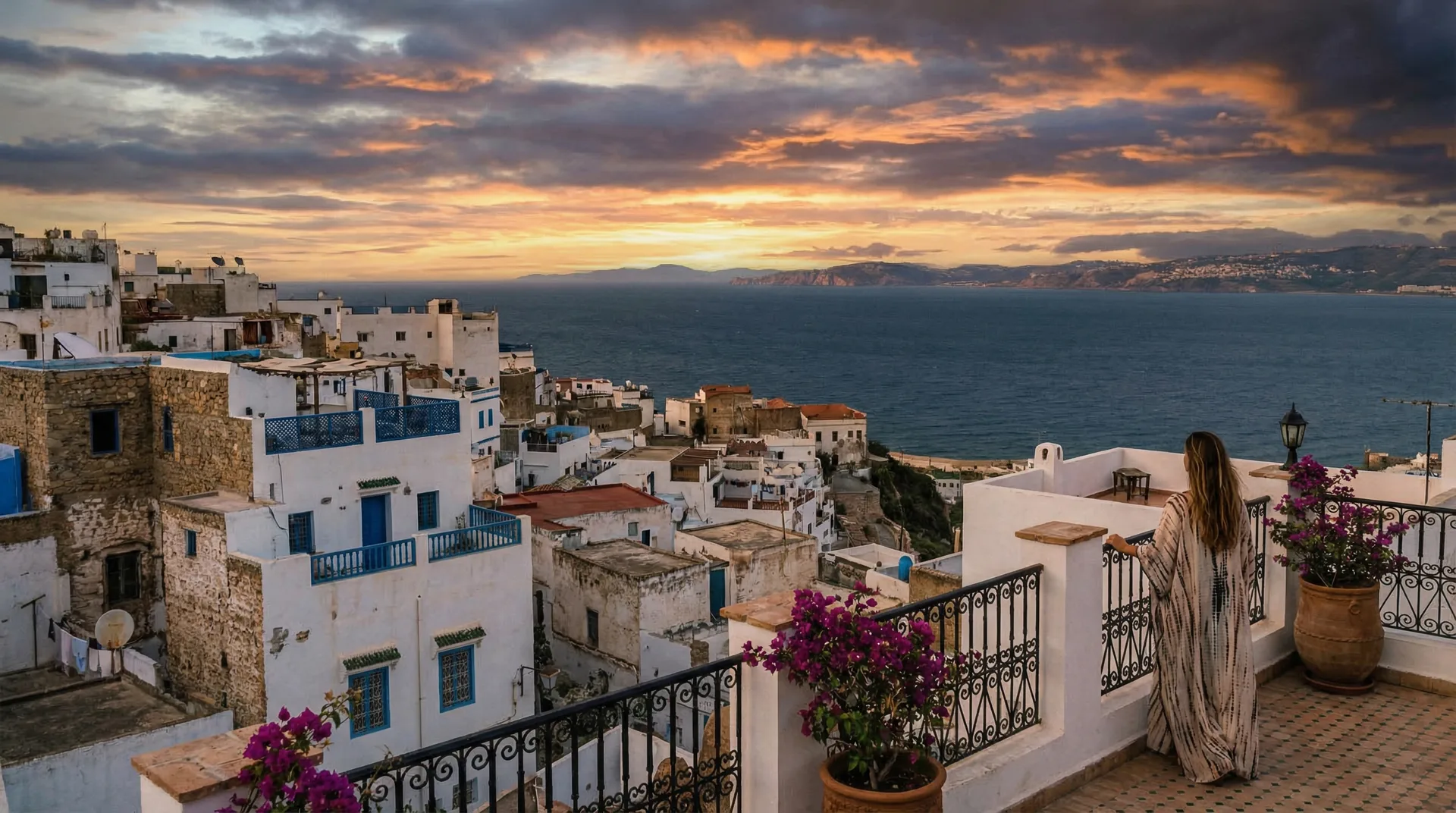
Yes — Tangier is worth visiting, and for more reasons than most guidebooks let on. It is a genuine Moroccan city with a character you will not find anywhere else in the country: a white kasbah and medina tumbling down to the Strait of Gibraltar, a literary and International-Zone past, superb seafood, and easy reach of Chefchaouen, Asilah and the Caves of Hercules. It is not the place for Saharan dunes or Marrakech-scale souks — those are far to the south. But as a gateway between Europe and Africa and a base for the north, Tangier earns at least two days. Here is the honest version, with the caveats included.
What makes Tangier worth visiting?
Tangier's appeal is that it is layered in a way few cities are. Phoenicians, Romans, Portuguese, the Spanish and the French all left marks here, and for three decades in the twentieth century the city was an International Zone governed by no single nation — a tax-free, loosely-policed crossroads that drew writers, spies, painters and chancers from across the world. That history is not a museum exhibit; it is in the architecture, the languages spoken on the street, the Spanish-tinged food and the faded grand cafés.
Concretely, the things that reward a visit:
- The kasbah and medina — compact, walkable, far less overwhelming than Fès or Marrakech, with views over the Strait that on a clear day reach the coast of Spain.
- The Grand and Petit Socco — the two market squares where the medina meets the modern city, best experienced over a mint tea while the city flows past.
- Café Hafa — clifftop terraces above the water, open since 1921, where the Beats and the Rolling Stones once sat.
- Cap Spartel and the Caves of Hercules — where the Atlantic and Mediterranean meet, a short drive west of the city.
- Seafood at the meeting of two seas — grilled fish straight off the boats and the Tangier fish tagine.
- The north on your doorstep — Chefchaouen, Asilah and Tetouan are all comfortable day trips.
Who will love Tangier — and who might not
Tangier rewards a particular kind of traveller and frustrates another. It is honest to say so.
You will love Tangier if you enjoy walkable port cities with atmosphere over checklists; you are crossing from Spain and want a real taste of Morocco; you are drawn to the literary, cosmopolitan, faded-glamour side of travel; you want a calm, characterful base for the north rather than a tourist machine; or you simply love good seafood and a sea breeze.
You may be underwhelmed if your mental image of Morocco is Saharan dunes, snake charmers and vast labyrinthine souks — that is Marrakech and the deep south, not the northern coast. You will also struggle if you give the city only a few hurried hours around the port, where unofficial 'guides' are most persistent and the most interesting parts of Tangier are easiest to miss.
Is Tangier worth it as a day trip from Spain?
A day trip from Tarifa is genuinely worth doing. The fast ferry crosses to Tangier Ville in about an hour, dropping you a short walk from the medina — Europe to Africa over breakfast, back in Spain for dinner. In a day you can walk the kasbah and medina, sit in the Petit Socco, and eat a seafood lunch. As a first stamp in Africa, it delivers.
The honest caveat: a day only shows you the city in its busiest, most exposed window. Tangier is best early in the morning and after dark, when the day-trippers and cruise crowds have gone, the light softens over the Strait and the cafés fill with locals. If you can stretch to one overnight, the city changes entirely. We cover the crossing in detail in our Tarifa ferry day-trip guide.
How does Tangier compare to Marrakech and Fès?
This is the comparison that decides most trips, so it is worth being blunt. The three cities are not competing versions of the same thing; they are different propositions.
- Marrakech is the most intense and souk-dense, the most geared to tourism, the easiest to fly into for the Sahara and the Atlas. It is also the busiest and the most commercial.
- Fès has the most medieval, labyrinthine medina in the country — extraordinary, but demanding, and easy to find overwhelming on a first visit.
- Tangier is the most Mediterranean and European-influenced, the calmest of the three to walk, and by far the easiest to reach from Spain. It trades scale and spectacle for atmosphere, sea air and a cosmopolitan past.
If you are flying into the south for a single Moroccan city, choose Marrakech or Fès. If you are crossing from Spain, basing yourself in the north, or drawn to the coastal, literary character, Tangier is very much worth it — and it pairs beautifully with Chefchaouen. Our Tangier vs Chefchaouen piece goes deeper on choosing a northern base.
How many days make Tangier worth the trip?
One day works only as a focused city walk, usually from the Spanish ferry — enough for the kasbah, medina and Soccos, but no more. Two full days is the sweet spot: the old city at an unhurried pace, the Corniche, Cap Spartel and the Caves of Hercules, and time to eat well. Three days adds a day trip to Chefchaouen or Asilah and turns Tangier into a proper short break rather than a stopover. We break the options down in How many days in Tangier?
What to know before you decide
Two practical points settle most lingering doubts. First, safety: Tangier is broadly safe for tourists, including solo and women travellers, with ordinary city common sense around petty scams and the unofficial 'guides' who work the port and medina gates — see our Tangier safety guide. Second, timing: spring and early autumn are ideal, summer is hot and busy with Moroccan beachgoers, and winter is mild but wetter. Neither is a reason to skip the city — both are simply worth planning around.
Our honest bottom line, after years of meeting guests off the ferry: Tangier is worth visiting for almost everyone who gives it more than a hurried afternoon. Walk the medina slowly, eat the fish, sit at Café Hafa as the light goes, and use the city as the gateway to the north it has always been.
Frequently asked
Is Tangier worth visiting?
Yes. Tangier is worth visiting for travellers who want a genuine Moroccan city with a distinct character — a hillside kasbah and medina above the Strait of Gibraltar, a literary and International-Zone history found nowhere else in Morocco, excellent seafood, and easy reach of Chefchaouen, Asilah and the Caves of Hercules. It is less worth a special detour if you want sweeping Saharan dunes or the souk-density of Marrakech, both of which are far to the south. As a gateway between Europe and Africa and a base for the north, it earns at least two days.
Is Tangier worth visiting as just a day trip from Spain?
A day trip from Tarifa is genuinely worthwhile — an hour across the Strait gives you the kasbah, the medina, the Grand and Petit Socco and a seafood lunch, and you are back in Spain by evening. But a day only scratches the surface. The city is at its best in the early morning and after dark, both of which a day-tripper misses. If Tangier is the only Morocco you will see, one overnight transforms it from a novelty crossing into a real visit.
Why do some people say Tangier is not worth it?
Most negative impressions come from two things: a rushed cruise-ship or ferry day spent mainly around the port and aggressive 'faux guides', and the expectation that Tangier will look like Marrakech or Fès. It does not. Tangier is a Mediterranean port city with European, Andalusian and Riffian layers — quieter, more faded, more cosmopolitan. Travellers who arrive expecting that, and who walk the medina with a little patience, rarely leave disappointed.
How many days do you need in Tangier?
Two full days lets you see the kasbah and medina properly, walk the Corniche, visit Cap Spartel and the Caves of Hercules, and eat well without rushing. Three days adds a day trip to Chefchaouen or Asilah. A single day works only as a focused city walk, typically from the Spanish ferry.
Is Tangier worth visiting compared to Marrakech or Fès?
They are different propositions. Marrakech is the most intense, souk-dense and tourist-oriented; Fès is the most medieval and labyrinthine. Tangier is the most Mediterranean, the most European-influenced and the easiest to reach from Spain. If you want one Moroccan city and you are flying into the south, choose Marrakech or Fès. If you are crossing from Spain, basing yourself in the north, or drawn to the literary, coastal, Strait-of-Gibraltar character, Tangier is very much worth it — and pairs naturally with Chefchaouen.
Is Tangier safe enough to make it worth visiting?
Yes. Tangier is broadly safe for tourists, including solo and women travellers, with the usual city-wide common sense around petty scams and persistent unofficial 'guides' near the port and medina gates. Violent crime against visitors is rare. Safety is not a reason to skip Tangier; see our dedicated safety guide for specifics.
What is the best time of year to visit Tangier?
Spring (April–June) and early autumn (September–October) are ideal — warm, clear and uncrowded. July and August are hot and busy with Moroccan domestic tourists who come for the beaches and the Strait breeze. Winter is mild but wetter, with Atlantic weather rolling through the city.
Make Tangier worth it
We turn a ferry stop into a real visit.
A guided medina walk, Cap Spartel and the Caves of Hercules, a day trip to Chefchaouen or Asilah, the right table for the fish. Private, paced to you, and built around what you actually want to see. Tell us how long you have.
Plan your Tangier trip