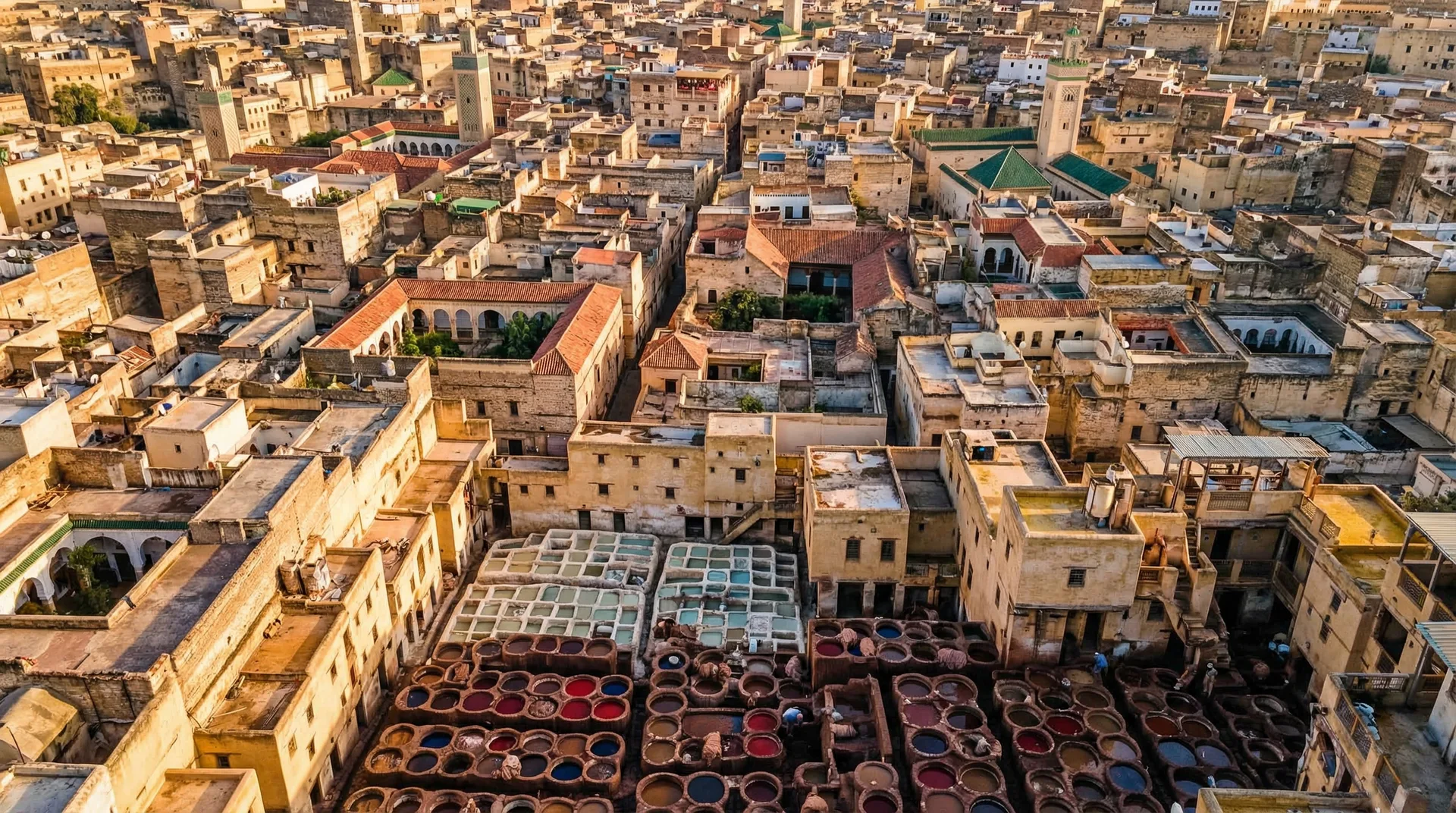
Tangier guards the western mouth of the Strait of Gibraltar, the point where the Mediterranean meets the Atlantic. Settled by Phoenicians, ruled in turn by Rome, Portugal and Spain, and governed for three decades as an international free zone, it is a city of layers. The medina and the kasbah above it are where those layers are easiest to read — and the most rewarding to walk slowly.
The case for a licensed guide
We say this gently but firmly: on a first visit, take a licensed guide for the morning. The medina lanes climb steeply and the signage is minimal — the old city was built for people who already knew it. A licensed guide (identified by an official badge) does three things a map cannot: they thread the logical circuit from the Grand Socco up to the kasbah, they explain the city's tangled history as you stand in it, and they absorb the persistent attention of the port touts so you don't have to. Budget US$50–90 for a full day; we arrange this as part of every Tangier itinerary.
The Petit Socco and the Grand Socco
The Petit Socco — the small square at the heart of the medina — was the throbbing centre of the International Zone, ringed by cafés where spies, smugglers and writers traded gossip. Today it is calmer, but the old café terraces remain the best place to sit and watch the medina move. From there the lanes climb to the Grand Socco (Place du 9 Avril 1947), the great hinge between the old walled city and the ville nouvelle, with the Cinema Rif and the adjacent Mendoubia Gardens.
Go in the morning, before the day-trip ferries land, for the fullest sense of the squares as working places rather than backdrops. Your guide will time it correctly.
The kasbah and the Kasbah Museum
At the top of the medina, the kasbah is the old citadel quarter, and at its heart the Kasbah Museum occupies the former Dar el Makhzen, the sultan's palace. Inside, Andalusian-style courtyards frame Phoenician and Roman finds, a fine floor mosaic, and rooms tracing the city's history. Step out onto the terrace and the whole reason for Tangier's existence becomes obvious — the Strait laid out below, the coast of Spain a clear line on the horizon.
Nearby, the small lanes of the kasbah hide the houses where Matisse painted, where Paul Bowles lived, and the spot where the Rolling Stones recorded local Jajouka musicians. Ask your guide; the literary and musical history is dense here.
Getting pleasantly lost
After the structured morning with a guide, ask them to leave you near the kasbah gate and spend an hour wandering the upper medina without an agenda. The lanes open suddenly onto sea views, neighbourhood bakeries send out the smell of bread, and the white-and-blue walls catch the Atlantic light. When you want to emerge, any local will point you toward the Grand Socco or the port in under a minute. Getting lost in the Tangier medina is safe; getting genuinely stuck is impossible.
Where to stay and what to eat
Stay inside the kasbah or upper medina in a guesthouse with a roof terrace — the contrast between the narrow lane outside and the sea view above is the defining Tangier experience. We work with a shortlist of houses where the restoration has been done with care; ask us when you enquire about a Tangier destination itinerary.
For food, Tangier is a fish city. The morning catch off the port becomes the day's grilled sardines and sea bass; calamari and prawns appear on every menu. Ask your guide for a neighbourhood restaurant near the port where a set fish lunch costs a fraction of the tourist-strip prices. Finish with mint tea at Café Hafa, on terraces above the sea since 1921.
The best time to visit
May, June, September and October offer ideal conditions — warm days in the low-to-mid 20s °C, sea breezes off the Strait, good light and smaller crowds than peak summer. July and August are hot and busy with Moroccan and Spanish holidaymakers. Winter (December to February) is mild but wet and windy on the Atlantic side, and deeply atmospheric — the medina at its quietest, cafés steamed up, the Strait grey and moody.
If your dates are flexible, the shoulder months let you pair the city with a day trip to Asilah or Chefchaouen in comfortable weather.
Frequently asked
Do you need a guide to explore the Tangier kasbah and medina?
A licensed guide is recommended for a first visit. The medina lanes wind steeply up to the kasbah with few obvious landmarks, and the city's layered history — Phoenician, Roman, Portuguese, the 1923–1956 International Zone — is easy to miss without one. A good guide takes you from the Grand Socco up through the medina to the Kasbah Museum in a logical loop.
How much does a private guide in Tangier cost?
Expect US$50–90 for a full-day licensed private guide, depending on coverage and whether they add Cap Spartel and the Caves of Hercules. Half-day medina and kasbah tours run US$30–50. Avoid unlicensed touts who approach you near the port — they earn commissions from shops, not from you.
How much time do you need in the Tangier medina?
Half a day covers the highlights: the Petit Socco, the Grand Socco, the medina lanes, the Kasbah Museum and the terrace views over the Strait. A full day lets you slow down, add the American Legation Museum and finish with tea at Café Hafa above the sea.
Can you visit the Kasbah Museum?
Yes. The Kasbah Museum occupies the former Dar el Makhzen, the sultan's palace at the top of the kasbah. It holds Phoenician and Roman artefacts, a fine mosaic and Andalusian-style courtyards, and the terrace gives one of the best views across the Strait of Gibraltar to Spain. A small entry fee applies.
Is Tangier safe for solo travellers?
Yes. The medina is generally safe during the day. The main nuisance is persistent offers of guidance from unofficial 'guides' near the port and Grand Socco. A polite but firm 'no thank you, I have a guide coming' usually ends it. Keep bags to your front in the busiest lanes, as anywhere.
What is the best time of year to visit Tangier?
May, June, September and October are ideal — warm days, sea breezes off the Strait and fewer crowds. July and August are hot and busy. Winter is mild but wet and windy, with the Atlantic side catching the weather first; the medina is at its quietest and most atmospheric then.
Ready to explore Tangier?
We'll arrange a licensed guide and the right kasbah house.
Every Tangier Tours programme includes a curated medina-and-kasbah morning with a licensed guide, accommodation handpicked for restoration quality and sea views, and a local restaurant shortlist.
Request a Tangier itinerary