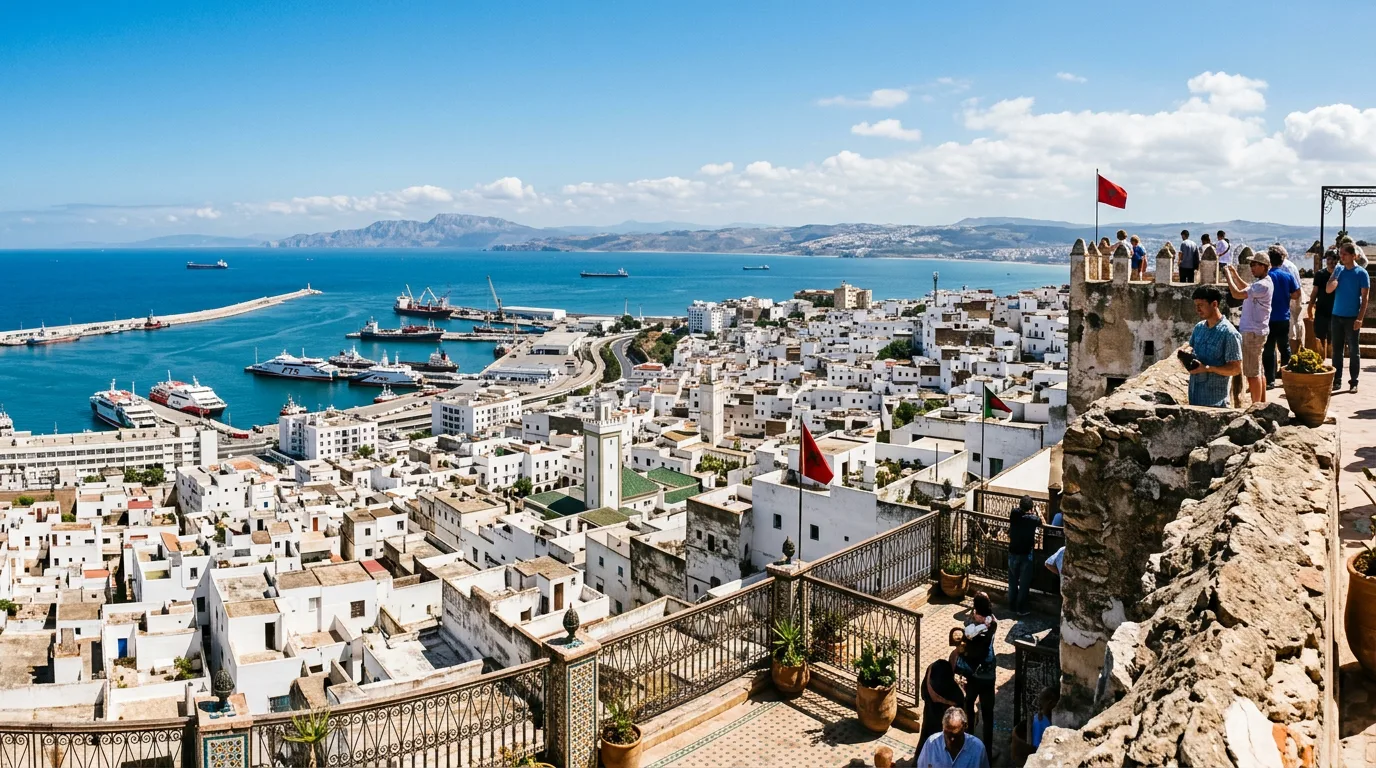
Spread along the cliff-tops west of the kasbah, the Marshan is one of Tangier's oldest residential quarters and the setting for its most atmospheric ancient relic — a cluster of tombs cut straight into the rock above the sea. Long known locally as the Phoenician (or Punic) tombs, these rectangular graves hewn into the bedrock sit on an open clifftop terrace looking out over the Strait of Gibraltar, a reminder that this corner of Morocco has been settled and buried over for thousands of years. Here is how to read the Marshan plateau, its rock-cut tombs and the cliff walk that links them to the kasbah and Café Hafa.
The Marshan's best-known sight is a group of graves carved directly into the flat rock of the clifftop — simple body-length rectangular cavities hollowed from the bedrock. Long associated locally with the Phoenician and Punic presence on this coast, they stand open to the sky on a terrace above the water, weathered and unfenced, with the sea immediately below.
02History
An ancient burial ground
Tangier sits on the site of ancient Tingis, a settlement with Phoenician and Carthaginian roots before it became a Roman city, and the Marshan tombs are usually read as part of that deep past. Precise dating and attribution are debated by archaeologists, so treat the 'Phoenician' label as the long-standing local tradition rather than a settled scientific fact.
03Views
The cliff-top setting over the strait
What makes the tombs unforgettable is less the carving than the position: an open, breezy ledge of rock high above the Strait of Gibraltar, with the Atlantic on one side and the Mediterranean on the other and, on clear days, the hills of Spain across the water. It is one of the finest free viewpoints in the city.
04Neighbourhood
The Marshan plateau
The Marshan is a leafy, largely residential plateau just west of the kasbah, historically a smart quarter of villas, consulates and gardens. Quieter than the medina below, its streets, the old palace grounds and the sea-facing edge reward a slow wander away from the tourist crowds.
05Cafés
Café Hafa nearby
A short walk from the tombs, the terraced Café Hafa has clung to the Marshan cliffs since the early 20th century, serving mint tea on tiers of seating that step down toward the sea. A legendary haunt of writers and musicians over the decades, it pairs naturally with a visit to the tombs for the same sweeping strait view.
06Walks
Walk from the kasbah
The Marshan adjoins the upper kasbah, so the easiest approach is on foot from the Kasbah Museum and the bab toward the Marshan, following the streets out to the sea edge. The walk threads from the old citadel into a calmer residential quarter in a few minutes and links the medina's high point to the clifftop.
07History
Hercules and the strait's mythology
This stretch of coast carries the legend of Hercules, whose labours were tied by ancient writers to the strait and the nearby Cap Spartel. Standing on the Marshan cliffs above the meeting of two seas, with the famous Caves of Hercules a short drive west, it is easy to see why classical imagination fixed on this threshold between worlds.
08Neighbourhood
Stadium and open ground
The Marshan is also home to one of the city's sports grounds and broad open spaces along the plateau, giving the quarter an airy, lived-in feel. The combination of everyday neighbourhood life with the ancient tombs at its edge is part of what makes a visit here feel less staged than the headline sights.
09Views
Sunset over two seas
Late afternoon is the moment to be on the Marshan edge: the light softens over the strait, ferries and fishing boats track across the water, and the tombs and café terraces catch the last sun. Bring a layer, as the clifftop is exposed and the wind off the sea can be brisk.
10Planning
Visiting respectfully
The tombs sit on open ground with no formal gate, ticket or facilities, so there is little signage and the rock can be uneven near the cliff edge — watch your footing and keep children close. Take your litter with you and treat the site as the ancient burial place it is rather than a playground.
Frequently asked
What are the Phoenician tombs in Tangier?
They are a group of graves cut directly into the bedrock on the clifftop of the Marshan quarter, west of the kasbah, overlooking the Strait of Gibraltar. They are traditionally linked to the Phoenician and Punic presence on this coast, though exact dating is debated, so the 'Phoenician' name is best taken as long-standing local tradition rather than confirmed fact.
Where is the Marshan and how do you get there?
The Marshan is a residential plateau on the cliffs just west of the kasbah, at the top of the medina. The simplest way to reach it is on foot from the Kasbah Museum, walking out through the upper old town to the sea-facing edge; it is only a few minutes' stroll and combines naturally with Café Hafa.
Is there an entry fee to see the tombs?
No. The tombs sit on open clifftop ground with no gate, ticket office or fixed opening hours. There are no facilities on site, so it is best visited as a short stop combined with the kasbah and Café Hafa, and the cliff edge calls for care underfoot.
What else is near the Marshan tombs?
The tombs sit beside Café Hafa, famous for its tiered sea-view terraces, and adjoin the upper kasbah and Kasbah Museum at the top of the medina. The clifftop view looks across the Strait of Gibraltar, and Cap Spartel and the Caves of Hercules lie a short drive west along the coast.
See it with a local
Turn this into a private Tangier trip.
We'll build a private, guided plan around the experiences you care about — with a driver, hand-picked riads and a written quote in 24 hours.