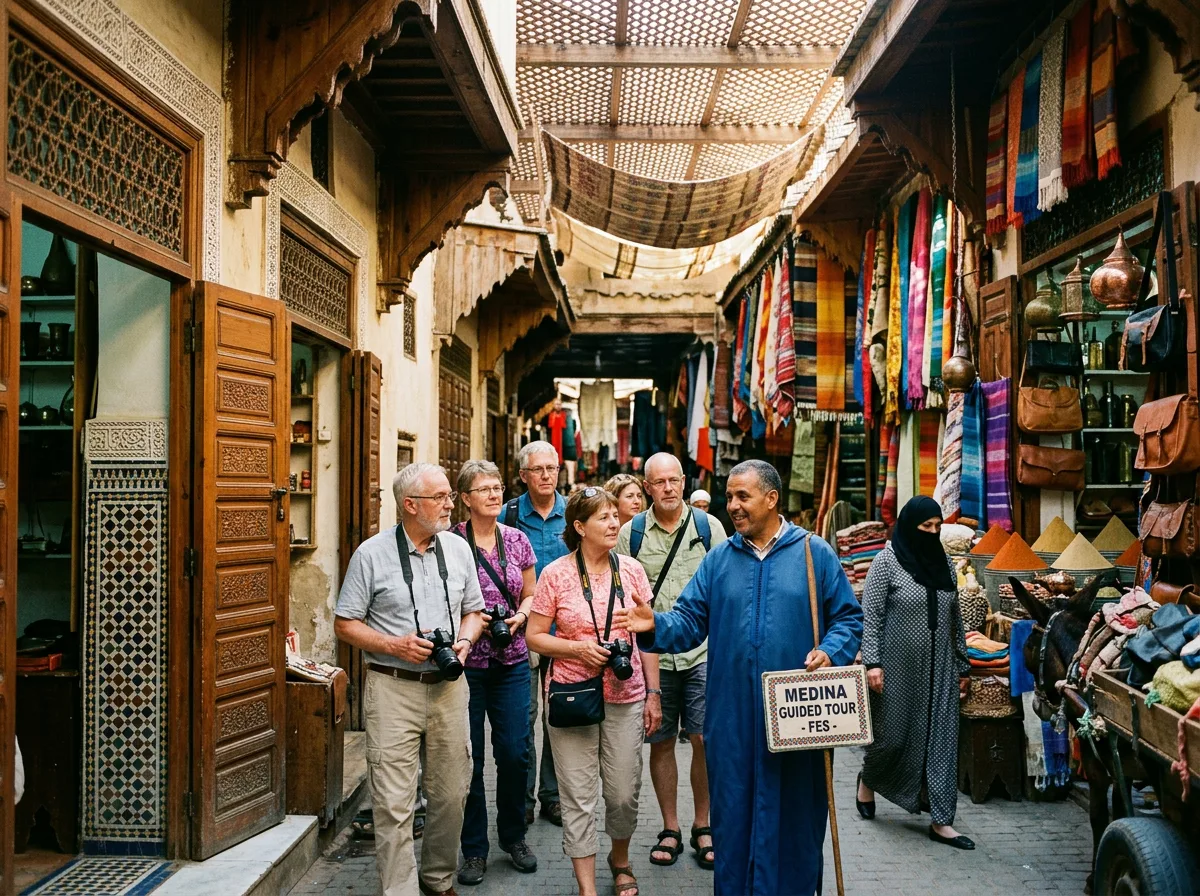
The old town is Tangier's heart — a hill of whitewashed lanes tumbling from the fortified kasbah down to the port. Andalusian, Moroccan and Mediterranean influences are stacked into its walls. Here is how to read the medina and its crowning citadel on foot.
The 17th-century sultan's palace anchors the kasbah and now holds the Museum of Mediterranean Cultures. Inside are Roman mosaics, Fez ceramics and a famous floor mosaic of the Voyage of Venus, set around tiled courtyards.
02Kasbah
Bab el-Assa & Place de la Kasbah
The 'gate of the bastinado' opens onto the kasbah's main square, where a viewpoint looks down over the medina rooftops to the harbour. It is the natural place to begin or end a walk through the upper town.
03Medina
Petit Socco
The medina's storied little square was the louche social centre of the International Zone, lined with cafés that drew writers, smugglers and diplomats. Its faded grandeur survives in the Café Central and the surrounding hotels.
04Medina
Rue es-Siaghin
The old jewellers' street links the Grand and Petit Soccos and remains the medina's busiest spine, lined with shops and the Spanish Church of the Immaculate Conception — a reminder of Tangier's cosmopolitan past.
05Medina
Grand Socco & Bab el-Fahs
The keyhole gate of Bab el-Fahs marks the threshold between the medina and the modern city on the Grand Socco. The plaza, officially Place du 9 Avril 1947, is the old town's main meeting point and market edge.
06History
The medina ramparts walk
Sections of the old defensive walls and bastions still ring the upper medina, with cannon platforms facing the sea. Following them gives a clear sense of how the hill town was fortified against attack from the strait.
07Culture
American Legation Museum
Tucked into the lower medina, this elegant building is the only U.S. National Historic Landmark abroad. It traces Moroccan-American ties back to 1777 and devotes a wing to the writer Paul Bowles, a long-time Tangier resident.
08Shopping
Artisan workshops
Beyond the tourist stalls, the medina still shelters working craftsmen — leatherworkers, weavers and metal-beaters. Buying directly from a workshop is the most honest way to take a piece of Tangier home.
Frequently asked
What is the difference between the medina and the kasbah in Tangier?
The medina is the whole walled old town of lanes, squares and homes. The kasbah is the fortified citadel at its highest point — historically the seat of power, containing the sultan's palace and the old defences. The kasbah sits inside, and above, the wider medina.
Is the Tangier medina safe to walk?
The medina is generally safe to explore on foot, including in the evening on the busier streets. The main nuisance is persistent faux-guides and touts near the port and Grand Socco; a firm, polite refusal usually settles it, and a hired guide removes the hassle entirely.
How long do you need for the medina and kasbah?
A focused walk through the medina and kasbah, with a museum stop, takes around half a day. Add the American Legation and some café time and it comfortably fills a leisurely morning into early afternoon.
Is the Kasbah Museum worth visiting?
Yes. Set in the former sultan's palace, the Kasbah Museum is worth it both for its collection — Roman mosaics, ceramics and the Voyage of Venus floor — and for the chance to walk through the tiled rooms and courtyards of the palace itself.
See it with a local
Turn this into a private Tangier trip.
We'll build a private, guided plan around the experiences you care about — with a driver, hand-picked riads and a written quote in 24 hours.