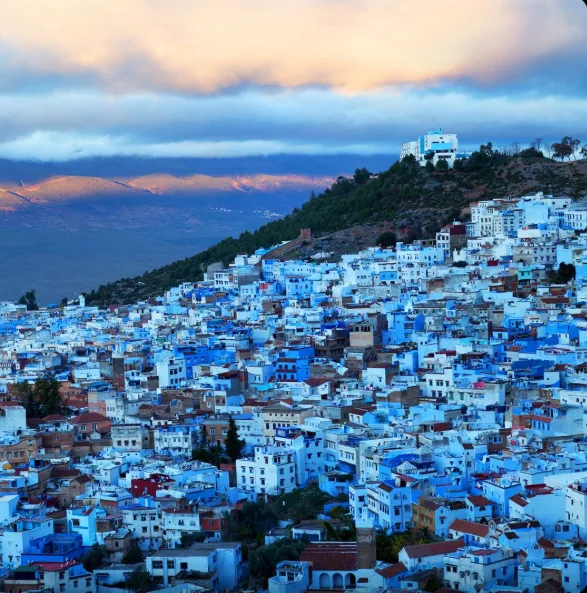
Tangier is a photographer's city — the light that drew Matisse and Delacroix, whitewashed walls against a deep-blue Strait, the kasbah's tangle of lanes, and day trips to the bluest town in Morocco. Knowing where to go, when, and how to engage respectfully makes all the difference.
In this guide
Best locations and light
The view from Café Hafa, terraced down the cliff above the Strait, is the classic Tangier frame — best in late afternoon as the light goes gold over the water and Spain shimmers across the channel. The kasbah ramparts and the Bab Bhar gate give you the medina rooftops tumbling toward the sea; shoot in early morning before the day-trippers arrive. The Petit Socco's café tables and the Grand Socco's bustle reward the patient observer at any hour.
Cap Spartel and the Caves of Hercules are at their best in late afternoon, when the sun drops toward the Atlantic and the famous Africa-shaped cave mouth glows. For day trips, Chefchaouen's blue-washed lanes photograph most beautifully from mid-morning before the buses arrive, and whitewashed Asilah's ramparts catch wonderful evening light against the Atlantic.
Medina etiquette and photographing people
The single most important rule: ask permission before photographing people, every time. A man at a café table, a woman in the medina, children playing in a kasbah lane — each deserves the choice. The Arabic to use is 'mumkin sura?' (may I take a photo?). Many will say yes with pleasure; some will ask for a small fee — 5–20 MAD is fair and generous; some will decline, and that decision must be respected without argument.
Street photography in the candid western tradition sits uneasily in Tangier's old town. Long lenses that allow unnoticed shooting of people who would decline if asked are widely considered disrespectful. The most rewarding portraits come from connection, not distance: take the time to talk, share a glass of tea on a terrace if invited, and the resulting images reflect that.
Gear and practical notes
The kasbah and medina are tight, steep spaces: a versatile zoom (24–70mm equivalent) or a mid-range prime is more useful than a long telephoto. The Strait throws strong, changeable light — a lens hood tames the flare off the water, and a polariser deepens that blue sea and sky. Salt spray and wind at Cap Spartel mean a cloth and a sealed bag are worth carrying.
- Bring a windproof for clifftop shoots — the Levante off the Strait is relentless on exposed coast.
- A small tripod or gorilla pod pays off for blue-hour kasbah scenes and the lighthouse at dusk.
- Phone cameras, particularly with computational photography, perform remarkably in Tangier's bright sea light — don't feel obliged to carry heavy gear.
- Keep your camera discreet around the port and the Grand Socco, where it draws unofficial 'guides'.
Drone rules in Morocco
Drone operation in Morocco requires authorisation from the Moroccan Civil Aviation Authority (DGAC). Flying without a permit is illegal, and drones have been confiscated at customs — a real risk arriving by ferry from Spain. The permit process is bureaucratic and slow. For most travellers, the advice is to leave the drone at home — Tangier's coast and kasbah are extraordinary at ground level, and the legal risk is not worth it.
Frequently asked
Where are the best photo spots in Tangier?
Café Hafa for the Strait view, the kasbah ramparts for medina rooftops over the sea, Cap Spartel and the Caves of Hercules at sunset, and the Petit and Grand Socco for street life. Day trips to Chefchaouen and Asilah add more.
When is the best time of day to photograph Tangier?
Golden hour — the hour after sunrise and before sunset — is transformative, especially with the Strait as a backdrop. The blue hour over the kasbah is equally remarkable. Midday, especially in summer, is harsh and flat.
Is it safe to use a camera in the Tangier medina?
Yes, in general. Keep it close around the port and the Grand Socco, and be aware of your surroundings. A strap worn across the body rather than over one shoulder is sensible.
Are drones allowed in Tangier?
Not without prior authorisation from the Moroccan DGAC. Drones have been confiscated at customs, including at the ferry port. Unless you have the time to navigate the permit process, leave the drone at home.
What is 'mumkin sura' and when should I use it?
'Mumkin sura?' means 'may I take a photo?' in Darija (Moroccan Arabic). Use it every time before pointing your camera at a person — it takes three seconds, shows genuine respect, and usually results in a much more natural and willing subject.
Planning a trip?
Let a Tangier atelier handle the details.
Tell us your dates and style and we'll send a written itinerary and a transparent quote within 24 hours.
Request an itineraryKeep reading
Culture
Tangier Etiquette & Customs
A little cultural awareness goes a long way in Tangier. The city is cosmopolitan and used to visitors off the Spanish ferries, but it is still Moroccan: dress modestly in the medina, greet warmly, ask before photographing people, and embrace the unhurried pace of mint tea on a café terrace.
Planning
The Best Time to Visit Tangier & Northern Morocco
Late spring (April–June) and early autumn (September–October) are the best all-round times for Tangier — warm but not heavy, the Strait breeze still gentle, and ideal conditions for the kasbah, the beaches and day trips to Chefchaouen, Asilah and Tetouan.
Itineraries
Northern Morocco Itinerary: 10 Days from Tangier
Ten days from Tangier is the sweet spot — long enough to soak up the gateway city and the Rif, then ride the high-speed train south to Fes and the imperial heart before circling back to the Strait.