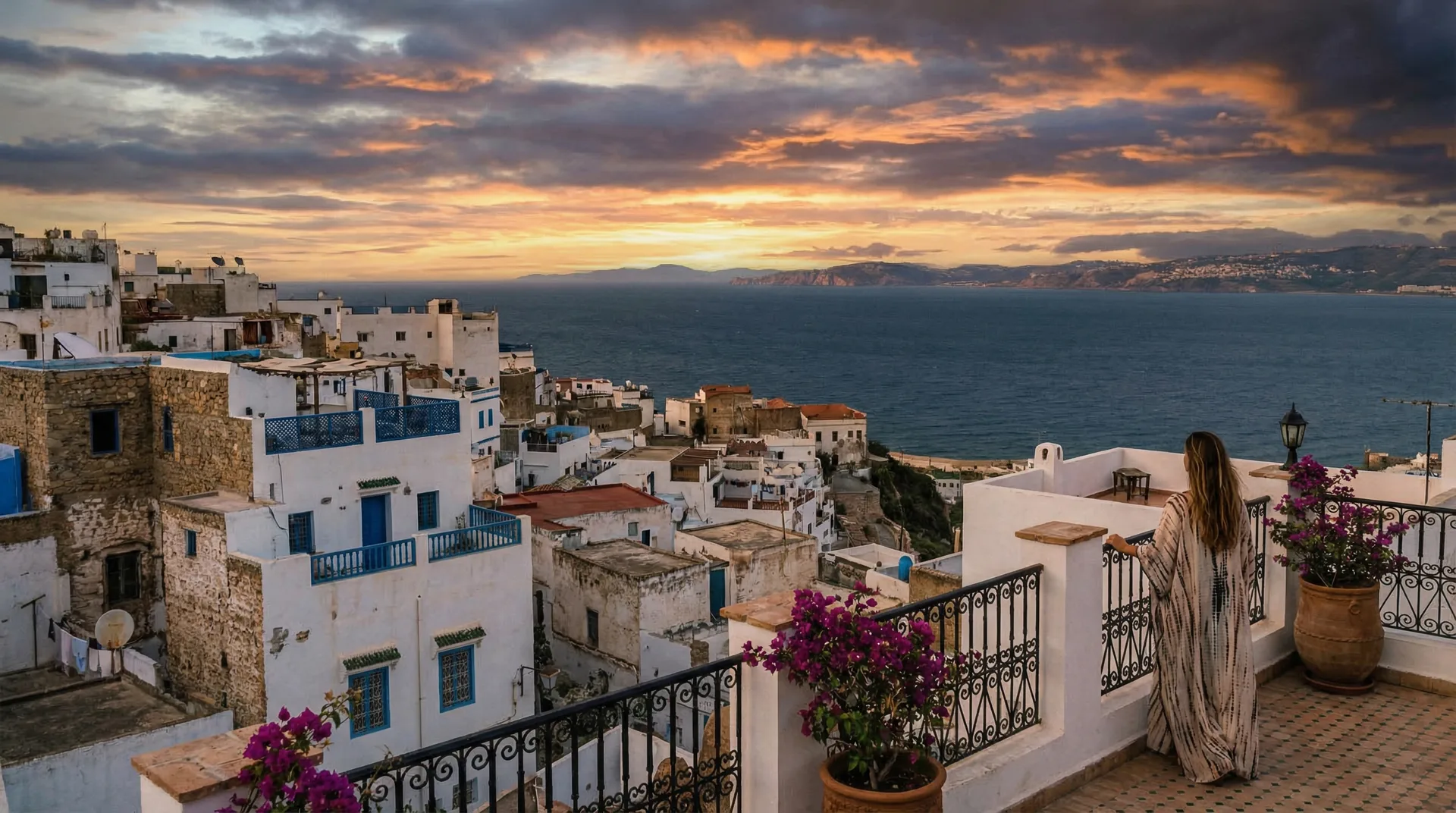
Tangier surprises people. Travellers arrive expecting a smaller version of Marrakech or Fes and find something quite different: a breezy, cosmopolitan port city at the very tip of Africa, looking straight across the Strait of Gibraltar at Spain. It has a faster, more European edge than the imperial cities inland, a long and storied history as an international crossroads, and a small, walkable old town wrapped in a thoroughly modern one. None of what follows is meant to put you off — Tangier is welcoming and rewarding. It's simply the handful of things we wish more first-time visitors knew before they stepped off the ferry.
The short version
- It's a gateway, not an imperial city: a cosmopolitan port with a more European, Mediterranean feel and a quicker pace.
- Spanish is everywhere: widely spoken alongside Arabic and French — a legacy of history and proximity.
- You can see Spain: across the Strait on a clear day, often startlingly close.
- The medina is small & walkable — but expect a few faux-guides near the port and the Soccos. A polite "no thank you" is all it takes.
- Stay overnight if you can: many come on a day trip from Spain, but dusk in the kasbah and Café Hafa are worth a night.
- Expect wind, dress modestly in the medina, and carry some cash even though cards work in modern spots.
1. Tangier feels different from the rest of Morocco
If you've travelled in Fes, Meknes or Marrakech, set those expectations gently aside. Tangier is a port and a gateway, and it wears that role in its character. For much of the twentieth century it was an "International Zone" — governed jointly by several foreign powers — and that era left behind the famous mid-century Interzone: a freewheeling, cosmopolitan, slightly bohemian city that drew writers, artists and drifters from across the world. The legacy lingers. Tangier today feels more Mediterranean and more outward-looking than the inland imperial cities, the pace is a touch quicker, and the European influence is everywhere — in the cafés, the architecture of the Ville Nouvelle, and the rhythm of daily life. It is unmistakably Moroccan, but Moroccan at its northern, sea-facing edge.
2. Spanish is widely spoken — and Spain is on the horizon
One of the first things people notice is the Spanish. Thanks to history and geography, Spanish is spoken widely here, alongside Moroccan Arabic (Darija) and French. You'll hear all three in a single afternoon, sometimes in a single conversation. A few words of Spanish or French go a surprisingly long way. And it isn't only the language: stand on the seafront, at Café Hafa or up at Cap Spartel on a clear day, and the coast of Spain is right there across the Strait — Tarifa and the hills of Andalusia, often closer than you'd expect. Two continents, two seas and two cultures genuinely meet here.
3. The medina is small and walkable — and you'll meet a few hustlers
Good news for the navigationally anxious: Tangier's medina is far smaller and easier to walk than the labyrinths of Fes or Marrakech. You can wander up from the Grand Socco, through the Petit Socco, and into the kasbah without much risk of being truly lost for long. The flip side is the city's most common minor annoyance: faux-guides and hustlers, concentrated around the port, the Grand Socco, the Petit Socco and the medina edges. The classic opening line is some version of "let me show you the kasbah" or an offer to walk you to "a good shop." It is almost never threatening — just persistent.
The way to handle it is simple and unbothered: a polite, firm "no thank you" (or "la, shukran"), no prolonged eye contact, and keep walking with purpose. Don't feel rude — it's the normal rhythm of the place, and most encounters end the moment you make clear you're fine on your own. If you would like a proper guided walk through the kasbah and medina, arrange a licensed guide in advance rather than accepting a spontaneous offer in the street; the history is richer with someone who genuinely knows it.
4. Many arrive as a day trip — but Tangier rewards an overnight
Because the fast ferry from Tarifa reaches the city-centre port in around an hour, a great many visitors come over from Spain just for the day. It works perfectly well for a first taste. But Tangier saves its best moments for the evening, when the day-trippers have caught the ferry back and the light turns gold. The kasbah at dusk, looking out over the Strait; a glass of mint tea at Café Hafa on its cliffside terraces above the sea; the quieter, more atmospheric evening medina — these are hard to fit into a few rushed daylight hours. If your itinerary allows it at all, give the city at least one night. For more on the crossing itself, see our ferry from Spain to Tangier guide.
5. It can be windy — pack for it
Tangier sits where the Atlantic meets the Mediterranean, and the Strait funnels the wind. Breezy days are common in every season — it's part of what keeps the summers comfortable, but it also means a warm afternoon can feel fresh on the exposed seafront, at Cap Spartel or on the open deck of a ferry. A light windproof layer earns its place in your bag year-round, and on the strongest days ferry crossings can occasionally be choppy. For a fuller seasonal breakdown, see our best time to visit Tangier guide.
6. Two cities in one: the medina and the modern Ville Nouvelle
Tangier really has two faces. There's the historic medina and kasbah climbing the hill above the port — old, atmospheric, best explored on foot. And there's the Ville Nouvelle, the modern town with broad boulevards, cafés, banks, shops and a thoroughly contemporary feel. Knowing this helps you set expectations: dress and behaviour can be more relaxed in the modern districts and along the beach promenade, while the medina and any religious sites call for the usual respect.
7. Dress modestly in the medina, relax elsewhere
Tangier is one of Morocco's more relaxed cities, but a little cultural awareness goes a long way and is always appreciated. In the medina, around the Soccos and near mosques, modest dress — shoulders and knees covered — is the comfortable, respectful choice for everyone. Along the beachfront and in the Ville Nouvelle things are noticeably more casual. As a general rule, dressing a touch more conservatively than you might at home smooths the way and is met warmly.
8. Carry cash, even though cards work in modern spots
Cards are accepted in hotels, modern restaurants and larger shops, particularly in the Ville Nouvelle, and ATMs are easy to find. But for the medina, small cafés, taxis, tips and the souks, cash is still king. Morocco's currency, the dirham, is best obtained locally from an ATM, and it helps to keep a stock of small notes and coins for everyday bits. Don't rely on tapping a card for a glass of tea or a petit-taxi fare.
9. It's safe and welcoming — just keep normal port-city awareness
Let's be clear and honest: Tangier is generally safe, and the overwhelming majority of visits are warm, friendly and entirely trouble-free. The hustling described above is an annoyance, not a danger. As in any busy port, sensible habits apply — keep an eye on your belongings in crowds around the port and the Soccos, take a little extra care late at night or in very quiet lanes, and use registered taxis. None of this should make you anxious; it's the same common sense you'd use in any port city in the world. For a deeper look, read our honest guide to safety in Tangier.
Frequently asked
What should I know before visiting Tangier?
Tangier is a cosmopolitan port and gateway city with a faster, more European edge than Morocco's imperial cities like Fes and Marrakech. Spanish is widely spoken alongside Arabic and French, you can see the coast of Spain across the Strait of Gibraltar, the medina is small and walkable, and the Ville Nouvelle is thoroughly modern. It's generally welcoming and safe — but you'll meet a few persistent faux-guides near the port and the Soccos, so it helps to know what to expect before you arrive.
Is Tangier different from the rest of Morocco?
Noticeably so. Decades as an 'International Zone' (the legendary mid-century Interzone) left Tangier with a cosmopolitan, Mediterranean character — part Moroccan, part Spanish, part Andalusian. It feels more European and more outward-looking than the inland imperial cities, the pace is a little quicker, and many visitors arrive by ferry from Spain rather than overland. It's still very much Morocco, just Morocco at its northern, sea-facing edge.
What language do they speak in Tangier?
Moroccan Arabic (Darija) is the everyday language, but Tangier is unusual in how widely Spanish is spoken — a legacy of its history and its closeness to Spain. French is also common, especially in business and hospitality, and you'll find English in tourist-facing places. A few words of Spanish or French go a long way here, perhaps more than in other Moroccan cities.
Are there hustlers or fake guides in Tangier?
You may meet some, mostly near the port, the Grand Socco, the Petit Socco and the edges of the medina. The usual approach is a friendly offer to 'show you the kasbah' or walk you to a shop. It's rarely threatening — just persistent. A polite, firm 'no thank you' (or 'la, shukran') and continuing to walk is enough. If you'd like a guided walk, arrange a licensed guide in advance rather than accepting a street offer.
Can you visit Tangier as a day trip from Spain?
Yes — the fast ferry from Tarifa reaches the city-centre port in roughly an hour, and many people do come over for the day. It works, but the city genuinely rewards an overnight: the kasbah at dusk, a mint tea at Café Hafa above the sea, and the quieter evening medina are hard to fit into a few daytime hours. If you can, stay at least one night.
Is Tangier safe for tourists?
Tangier is generally safe and welcoming, and most visits are completely trouble-free. As in any busy port city, it pays to keep normal awareness — watch your belongings in crowds around the port and Soccos, and use a bit more care late at night or in very quiet lanes. Petty hustling is more common than any real danger. Use registered taxis and keep some cash on you.
Arrive ready
Let us show you the real Tangier — beyond the port hustle.
We live and work in Tangier, and we love introducing first-time visitors to the city we know: the kasbah at dusk, the quiet corners of the medina, Café Hafa and the view across to Spain. Tell us when you're coming and we'll build a trip that fits.
Request an itinerary