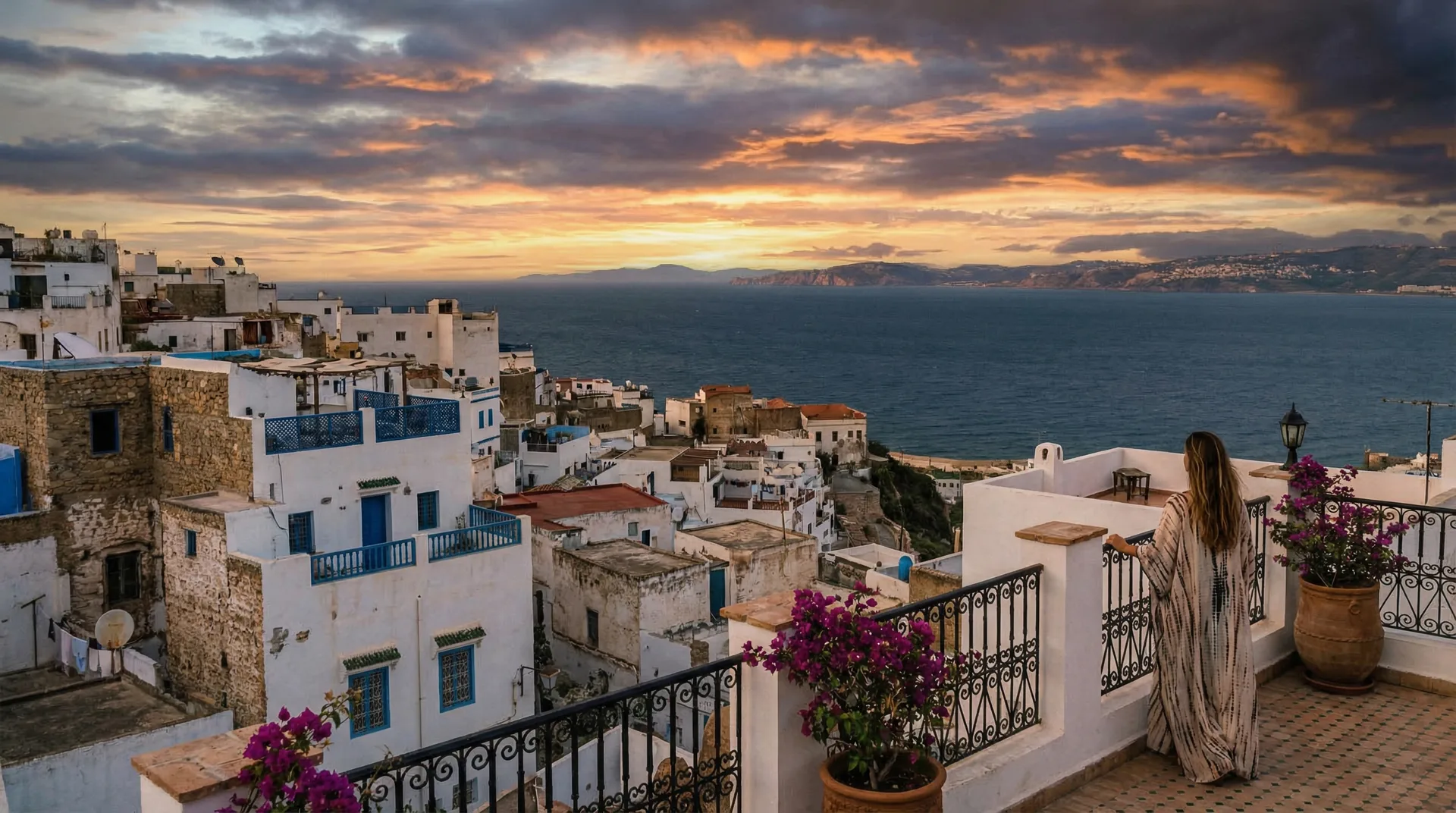
Short answer: yes, Tangier is worth visiting, and the smart way to do it is to treat the city as a base for the whole of northern Morocco rather than a one-day ferry stop. Give Tangier itself two days — the kasbah, the medina, the Grand and Petit Socco, the Corniche and Cap Spartel — then add day trips: Chefchaouen (the blue city, about two hours each way), Asilah (whitewashed coast, about 45 minutes), Tetouan (an Andalusian UNESCO medina, about an hour) and the Caves of Hercules just west of town. From Spain, the Tarifa fast ferry puts you in the centre of Tangier in about an hour. Spring and early autumn are the best times to come. Here is the honest, planned version.
Is Tangier worth visiting?
Yes — for the right traveller, and with one caveat. Tangier is a genuine Moroccan city with a character you won't find elsewhere in the country: a white kasbah and medina tumbling down to the Strait of Gibraltar, layers of Phoenician, Roman, Portuguese, Spanish and French history, and three decades as a freewheeling International Zone that drew writers, painters and spies. It is calmer and more Mediterranean than Marrakech or Fès, easy to walk, and superb for seafood. The caveat: if your mental image of Morocco is Saharan dunes and vast labyrinthine souks, that is the deep south, not the northern coast — and a rushed few hours around the port will undersell the city badly. We make the full case in Is Tangier worth visiting?
What is there to do in Tangier itself?
Enough to fill two unhurried days before you ever leave the city. The core of any visit is the old town and the seafront:
- The kasbah and medina — compact and walkable, far less overwhelming than Fès, with terraces and viewpoints over the Strait that on a clear day reach the coast of Spain.
- The Grand and Petit Socco — the two market squares where the medina meets the modern city, best taken slowly over a mint tea.
- Café Hafa — clifftop tea terraces above the water, open since the 1920s, where the Beats and the Rolling Stones once sat.
- The Kasbah Museum and the American Legation — the best small museums for the city's layered, cosmopolitan story.
- The Corniche and city beach — a long seafront walk toward the marina and Cap Malabata, with the port and the Strait on one side.
- Seafood where two seas meet — grilled fish off the boats and the Tangier fish tagine.
If you only have one full day, our Tangier in three days plan and the kasbah and medina walking guide show how to sequence it without getting lost.
Which day trips from Tangier are best?
This is the question that shapes most northern trips. Four day trips are worth your time, and they suit different travellers. Drive times are one-way and approximate — traffic leaving Tangier and the mountain road to Chefchaouen are the main variables.
Chefchaouen — the blue city (about 2 to 2½ hours)
The bucket-list day trip: a blue-washed medina climbing the Rif mountains, endlessly photogenic and genuinely unlike anywhere else. The honest trade-off is the drive — four to five hours round-trip means a long day with a few unhurried hours on the ground. It is well worth it once, and even better as an overnight. There is no train; see how to get from Tangier to Chefchaouen and our blue-city day-trip guide.
Asilah — whitewashed Atlantic coast (about 45 minutes)
The easiest and most relaxed day out: Portuguese ramparts, a mural-painted medina, a working harbour and long beaches, all under an hour south on the motorway. Perfect for a gentle half or full day, and ideal if Chefchaouen's drive feels like too much. Full details in our Asilah day-trip guide.
Tetouan — Andalusian UNESCO medina (about 1 hour)
The most under-visited of the four and a favourite of repeat travellers: a UNESCO-listed medina with strong Andalusian roots, whitewashed lanes and far fewer tourists than Chefchaouen. An hour east of Tangier, it pairs well with the drive toward the mountains.
Cap Spartel & the Caves of Hercules (about 20–30 minutes)
The closest excursion and an easy half day: the lighthouse at the northwest tip of Africa, where the Atlantic meets the Mediterranean, and the Africa-shaped sea cave just below. Combine it with a beach lunch on the Atlantic coast. See our Cap Spartel & Caves of Hercules guide.
If you can only do two, the most common pairing is Chefchaouen (the highlight) plus a relaxed afternoon at Cap Spartel or Asilah.
How many days do you need for Tangier and the north?
One day covers only the old city, usually off the Spanish ferry. Two days does Tangier properly — kasbah, medina, Soccos, Corniche and Cap Spartel. Three to four days adds one or two day trips, most often Chefchaouen plus Asilah. Five to seven days allows a full northern loop with Tetouan and an overnight in Chefchaouen, taking the pressure off the long mountain drive. We size it all up in How many days in Tangier? and lay out a week in our 7-day northern itinerary.
How do you get to Tangier from Spain?
The fast ferry from Tarifa crosses to Tangier Ville — the central, walkable port a short stroll from the medina — in about an hour, which is why it is the foot passenger's choice. Crossings from Algeciras are cheaper and more frequent but dock at Tanger Med, around 45 minutes east of the city, so you will need onward transport. Two things catch people out: the one-hour time difference between Spain and Morocco, and the passport stamp, which is handled on board. Full detail in our Tarifa vs Algeciras ferry guide and the day-trip-from-Spain guide. Once you are in the north, getting between the towns is easiest with a private driver — see driving vs hiring a driver.
When is the best time to go?
Spring (April–June) and early autumn (September–October) are the sweet spots — warm, clear and uncrowded, and comfortable both in the city and up in the Rif. July and August are hot and lively, busy with Moroccan beachgoers drawn to the Strait. Winter is mild on the coast but wetter, and Chefchaouen in the mountains can be cold and rainy. We break it down month by month in the best time to visit Tangier guide.
The bottom line, after years of meeting guests off the ferry: Tangier is worth visiting for almost anyone who gives it more than a hurried afternoon — and it is at its best used as the gateway to the north it has always been. Two days in the city, a couple of well-chosen day trips, and you have seen the most rewarding corner of Morocco that most visitors miss entirely.
Frequently asked
Is Tangier worth visiting?
Yes — Tangier is worth visiting for travellers who want a genuine, walkable Moroccan port city with a character found nowhere else in the country: a hillside kasbah and medina above the Strait of Gibraltar, a literary International-Zone past, excellent seafood, and easy reach of Chefchaouen, Asilah, Tetouan and the Caves of Hercules. It is less of a special detour if your heart is set on Saharan dunes or Marrakech-scale souks, both far to the south. As the gateway between Europe and Africa and a base for the north, it earns at least two days.
What are the best day trips from Tangier?
The four classic day trips are Chefchaouen (the blue mountain town in the Rif, about two to two and a half hours each way), Asilah (a whitewashed, mural-painted coastal town roughly 45 minutes south), Tetouan (a UNESCO-listed Andalusian medina about an hour east), and Cap Spartel with the Caves of Hercules (about 20–30 minutes west, where the Atlantic meets the Mediterranean). Chefchaouen and Cap Spartel are the most popular; Asilah is the easiest and most relaxed; Tetouan is the most under-visited.
How many days do you need in Tangier and the north?
Two full days covers Tangier itself — the kasbah, medina, the Soccos, the Corniche and Cap Spartel — without rushing. Three to four days lets you add one or two day trips (most people pick Chefchaouen plus Asilah). A full northern loop including Tetouan and an overnight in Chefchaouen works well as five to seven days. A single day, usually off the Spanish ferry, only covers the old city.
How do you get from Spain to Tangier?
The fast ferry from Tarifa crosses to Tangier Ville (the central, walkable port) in about an hour and is the best option for foot passengers. Ferries from Algeciras are cheaper and more frequent but dock at Tanger Med, around 45 minutes east of the city. Remember the one-hour time difference between Spain and Morocco, and bring your passport — it is stamped on board.
Is Chefchaouen or Asilah the better day trip from Tangier?
They are different. Chefchaouen is the bucket-list blue city in the Rif mountains — photogenic and memorable, but a longer drive (around two hours each way), so the day is mostly travel plus a few unhurried hours. Asilah is far closer (about 45 minutes), calmer and coastal, ideal if you want a gentle half or full day by the Atlantic. If you only have time for one and don't mind the drive, most first-timers choose Chefchaouen; if you want a relaxed day, choose Asilah.
When is the best time to visit Tangier and northern Morocco?
Spring (April–June) and early autumn (September–October) are ideal — warm, clear and uncrowded, with comfortable conditions for both the city and the Rif. July and August are hot and busy with Moroccan domestic tourists drawn to the beaches and the Strait breeze. Winter is mild but wetter, with Atlantic weather rolling through; Chefchaouen in particular can be cold and rainy in the mountains.
Plan the whole north
One trip, the city and the day trips — built around you.
A guided Tangier medina walk, Cap Spartel and the Caves of Hercules, and day trips to Chefchaouen, Asilah or Tetouan with a private driver. Paced to your days, not a coach timetable. Tell us how long you have and what you most want to see.