Here is the honest version: Morocco is co-hosting the 2030 FIFA World Cup with Spain and Portugal, and Tangier has been named one of Morocco's host cities, with the Grand Stade de Tanger (the Ibn Batouta stadium) as its venue. That much is confirmed. Almost everything else travellers want to pin down — the exact match schedule, dates, ticket prices, fan-zone plans and the stadium's final capacity after any upgrade — is not yet finalised, so check official FIFA and Moroccan announcements closer to the time. The good news for planning is that Tangier is already an easy, rewarding city to reach and to spend time in: a fast ferry from Spain, the Al Boraq high-speed train across Morocco, its own airport, and a walkable old town with some of the best day trips in the country on its doorstep. Here is how to think about it.
What's actually confirmed about Tangier hosting?
Two things, and it is worth being precise about them. First, the 2030 World Cup is a three-country tournament co-hosted by Morocco, Spain and Portugal — the first time the event has been shared across two continents in this way, which is part of what makes the Tangier angle so interesting. Second, Tangier is one of the announced Moroccan host cities, and the city already has a stadium, the Grand Stade de Tanger, also known as the Ibn Batouta stadium.
Beyond that, we would urge caution. As of now, the detailed fixture list — how many matches Tangier hosts, against whom and on which dates — has not been published. Nor have ticket prices, official fan-zone locations, or the stadium's final seated capacity following any renovation. Those details are exactly the kind that change, so we are not going to invent them. When they are confirmed, they will come through official FIFA and local channels, and that is where to look before you commit to specific match days.
How do you get to Tangier?
This is where Tangier genuinely shines, and none of it depends on the World Cup — the routes below are all live and well established today. Tangier sits at the meeting point of Europe and Africa, so you can arrive by sea, by high-speed rail or by air.
The Al Boraq high-speed train (confirmed and running)
Tangier is the northern terminus of Morocco's Al Boraq high-speed line, which links the city with Kenitra, Rabat and Casablanca. This is a real, operating service — Africa's first high-speed rail — so if you are combining Tangier with other Moroccan cities, the train is fast, comfortable and reliable. Given that Spain is a co-host, the ability to land or watch a match further south and reach Tangier by high-speed rail is a real practical advantage. We cover the local and regional options in our getting around Tangier guide.
Ferries from Spain across the Strait
Because Spain co-hosts, the Strait crossing matters more than ever. The fast ferry from Tarifa reaches Tangier Ville — the central, walkable port — in about an hour, which makes it the foot passenger's choice. Crossings from Algeciras are frequent but dock at Tanger Med, roughly 45 minutes east of the city, so you will need onward transport. Two things catch people out: the one-hour time difference between Spain and Morocco, and the passport stamp, handled on board. Full detail is in our Tarifa vs Algeciras ferry guide and the day-trip-from-Spain guide.
Ibn Battouta Airport (TNG)
Tangier has its own airport, Ibn Battouta Airport (TNG), a short drive west of the centre, with connections to a range of European cities and elsewhere in Morocco. For many visitors, flying into Tangier directly — or into another Moroccan or Spanish city and finishing the journey by rail or ferry — will be the simplest route.
When should you start planning and booking?
Our honest advice: follow the official announcements, and book the moment your match days are confirmed. During any World Cup, host-city accommodation fills quickly and prices climb, so the travellers who do best are the ones ready to move as soon as the schedule lands. Until then, it is hard to commit to exact dates — and we will not quote tournament-period prices, because none are confirmed. If you are flexible, the calmer, cheaper way to experience Tangier is simply to visit outside the tournament window; our best time to visit Tangier guide breaks down the seasons.
Where to stay — medina and kasbah, or the bay and city?
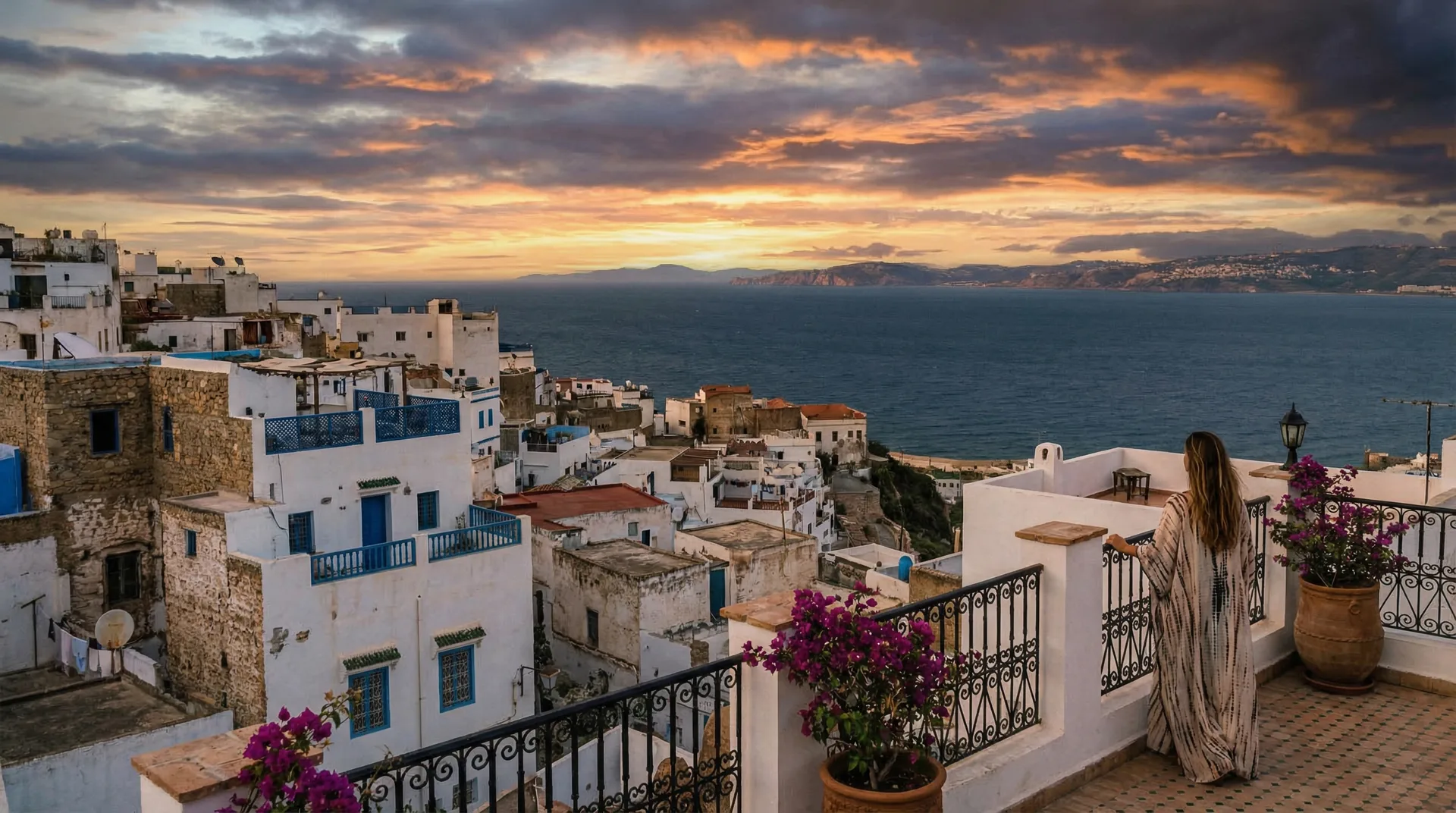
Broadly, Tangier gives you two characters to choose between. The kasbah and medina put you in the atmospheric old heart — car-free lanes, terraces over the Strait, guesthouses with sea views and breakfast above the water. It is the most memorable place to stay, though bags and arrivals take a little more effort on foot. The bay and modern city — along the Corniche toward the marina and Malabata — give you easier access, larger hotels and the seafront, which can suit anyone arriving late or travelling with more luggage.
We weigh the trade-offs in where to stay in Tangier, and describe what a night in the old town is really like in staying in the Tangier kasbah. For a tournament trip, book whichever you choose well ahead.
What to do between matches in Tangier
There is more than enough to fill the days around any fixtures. The heart of a Tangier visit is the old city and the seafront:
- The kasbah and medina — compact and walkable, with terraces and viewpoints over the Strait that on a clear day reach the coast of Spain. Our kasbah and medina walking guide shows how to wander without getting lost.
- The Grand and Petit Socco — the two market squares where the medina meets the modern city, best taken slowly over a mint tea.
- Café Hafa — clifftop tea terraces above the water, open since the 1920s, where the Beats and the Rolling Stones once sat.
- The Kasbah Museum and the American Legation — the best small museums for the city's layered, cosmopolitan story.
- Cap Spartel and the Caves of Hercules — the northwest tip of Africa, where the Atlantic meets the Mediterranean, an easy half day just west of town.
- Seafood where two seas meet — grilled fish off the boats and the Tangier fish tagine; see our Tangier food guide.
Easy day trips from Tangier
One of Tangier's strongest cards is what lies within an easy drive. If you have free days around the football, these are the four to consider — drive times are one-way and approximate.
- Chefchaouen, the blue mountain town in the Rif, about two to two and a half hours each way — the bucket-list day out. See the blue-city guide and how to get there, or our Chefchaouen day trip.
- Asilah, a whitewashed, mural-painted coastal town about 45 minutes south — the easiest and most relaxed option. See the Asilah day-trip guide and our Asilah ramparts & murals tour.
- Tetouan, a UNESCO-listed Andalusian medina about an hour east and the most under-visited of the four. Our Tetouan & Martil day tour makes an easy outing.
- Cap Spartel & the Caves of Hercules, about 20–30 minutes west — the closest excursion. See the Cap Spartel guide or the Cap Spartel half-day tour.
If you want to string several together, our northern Morocco planning guide and the 7-day northern itinerary show how the region fits together.
Is Tangier worth visiting outside the World Cup too?
Yes — and this is the part we would most want a first-time visitor to hear. The football is a wonderful reason to come, but Tangier earns a trip in any year. It is a genuine port city with a character found nowhere else in Morocco: a white kasbah and medina above the Strait of Gibraltar, layers of Phoenician, Roman, Portuguese, Spanish and French history, three decades as a freewheeling International Zone that drew writers and artists, and some of the best seafood in the country. Add the high-speed rail, the ferries from Spain and the day trips above, and you have one of the most accessible and rewarding corners of Morocco. We make the full case in is Tangier worth visiting?
The bottom line: build your plans around what is confirmed — Tangier as a host city, reachable by ferry, rail and air — and stay flexible on the details until the official schedule and ticketing are published. Get the travel and the base right, give yourself a couple of day trips, and you will see the most rewarding corner of Morocco that most visitors miss entirely, World Cup or not.
Frequently asked
Is the 2030 World Cup schedule confirmed yet?
No. As of mid-2026 the detailed match schedule — which fixtures play in which city, exact dates and kick-off times — has not been finalised and published. What is confirmed is that the 2030 FIFA World Cup is being co-hosted by Morocco, Spain and Portugal, and that Tangier is one of the announced Moroccan host cities, with the Grand Stade de Tanger (Ibn Batouta) as its venue. Treat anything beyond that — fixtures, ticket prices, fan-zone details, final stadium capacity after any renovation — as not yet confirmed, and check official FIFA and local announcements closer to the event.
Is Tangier definitely a 2030 World Cup host city?
Yes. Tangier has been named as one of Morocco's host cities for the 2030 tournament, and the city already has a stadium, the Grand Stade de Tanger (also called the Ibn Batouta stadium). Exactly how many matches it will host, on which dates, and what the venue's final configuration will be after any upgrade work are details that have not yet been confirmed publicly — so plan around the city being a host, but wait for the official schedule before booking specific match days.
How will fans travel between the Spanish and Moroccan host cities?
The natural link is the Strait of Gibraltar. Fast ferries already run from Tarifa to Tangier Ville in about an hour, and from Algeciras to Tanger Med, so crossing between southern Spain and Tangier is genuinely easy today. Inside Morocco, the Al Boraq high-speed line connects Tangier with Kenitra, Rabat and Casablanca, which is a real, working service right now. How ferry and rail capacity, schedules and any special tournament services will be arranged for 2030 has not been announced — but the core infrastructure for cross-strait travel already exists.
When should I book travel and accommodation for the 2030 World Cup in Tangier?
As early as you sensibly can once the official match schedule is released, because host-city beds during a World Cup fill fast and prices rise. Until fixtures are confirmed it is hard to commit to exact dates, so a reasonable approach is to follow official FIFA and Moroccan announcements, then book accommodation and cross-strait transport as soon as your match days are known. We do not quote tournament-period prices because none are confirmed.
Is Tangier worth visiting outside the World Cup?
Very much so. Tangier is a genuine, walkable port city on the Strait of Gibraltar with a hillside kasbah and medina, a celebrated literary past, excellent seafood, and easy reach of Chefchaouen, Asilah, Tetouan and the Caves of Hercules. It rewards a visit in any year, and the high-speed Al Boraq line plus ferries from Spain make it one of the most accessible corners of Morocco regardless of the football.
What is the closest airport, and how do I reach Tangier without flying?
Tangier has its own airport, Ibn Battouta Airport (TNG), a short drive west of the centre. You can also arrive without flying: take a fast ferry from Tarifa or Algeciras in southern Spain, or reach Tangier from Casablanca, Rabat or Kenitra on the Al Boraq high-speed train. All three options — air, sea and rail — are live and well established today.
Plan ahead with people on the ground
A Tangier trip built around you — football or not.
A guided Tangier medina walk, Cap Spartel and the Caves of Hercules, and day trips to Chefchaouen, Asilah or Tetouan with a private driver. Paced to your days, not a coach timetable. Tell us how long you have and what you most want to see, and we will help you watch the announcements and book at the right moment.